The Jan Kjellstrom Orienteering Festival is the UK's premier orienteering event, attracting upwards of 2000 competitors each year. It takes place over the Easter weekend, with a sprint on the friday, a middle on Saturday, long on Sunday and a relay on the Monday.
In early November Jon Cross, the overall event coordinator, asked if Fiona and I would be interesting in planning the sprint. Having only done organising for the last couple years, it felt like a nice opportunity to mix things up a bit.
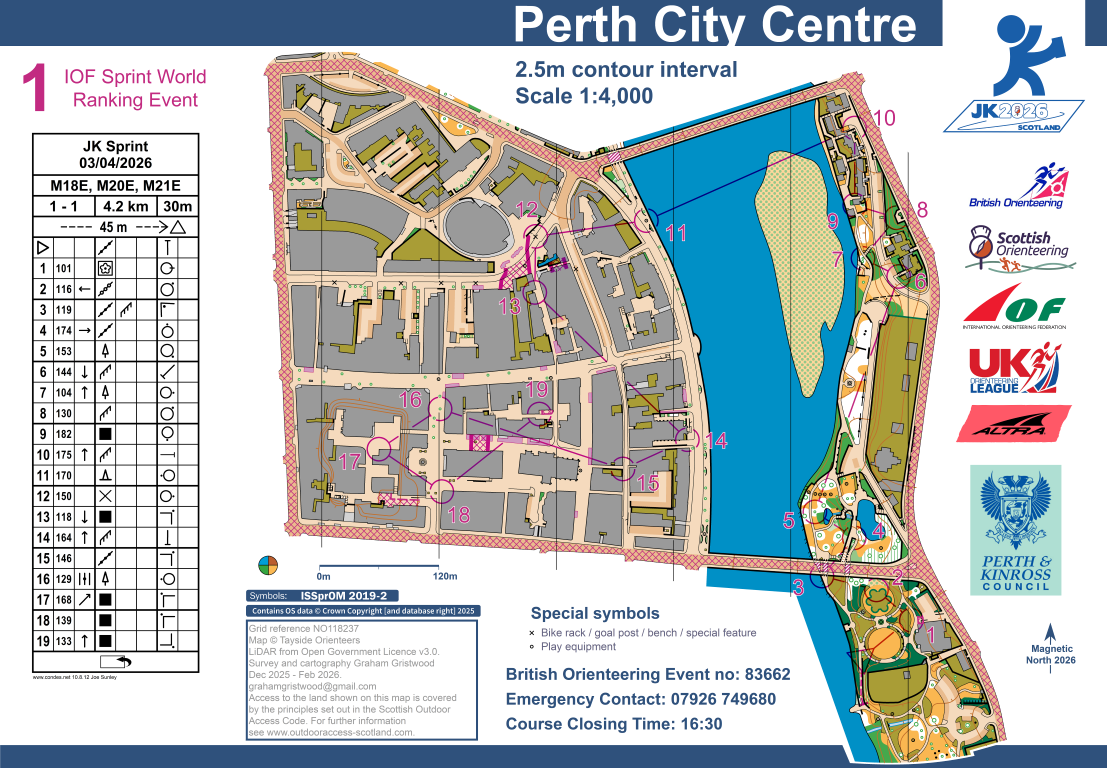
The Area
Perth was previously used for a Park World Tour race in 2010. The area can be divided into 3 distinct sections with different types of orienteering required:
- Perth City Centre - Typical urban orienteering, large blocks with typically 50/50 routechoices
- Rodney Gardens & Norrie Miller Walk - Tight, twisty park
- North Inch - More open, larger routes with some typically housing estate in the centre
Starts
It was quite obvious when we started that we would have 2 starts, one in North Inch, the other in Rodney Gardens.
Unfortunately, Rodney Gardens is very small so unsuitable to host a large number of courses (~600 competitors compared to ~1000 at the Blue Start). We decided that of the 2 starts, Rodney Gardens provided the most technical challenge so we would obviously have the elite courses there, we then decided to keep it simple and have the next 4 longest courses there.
Map
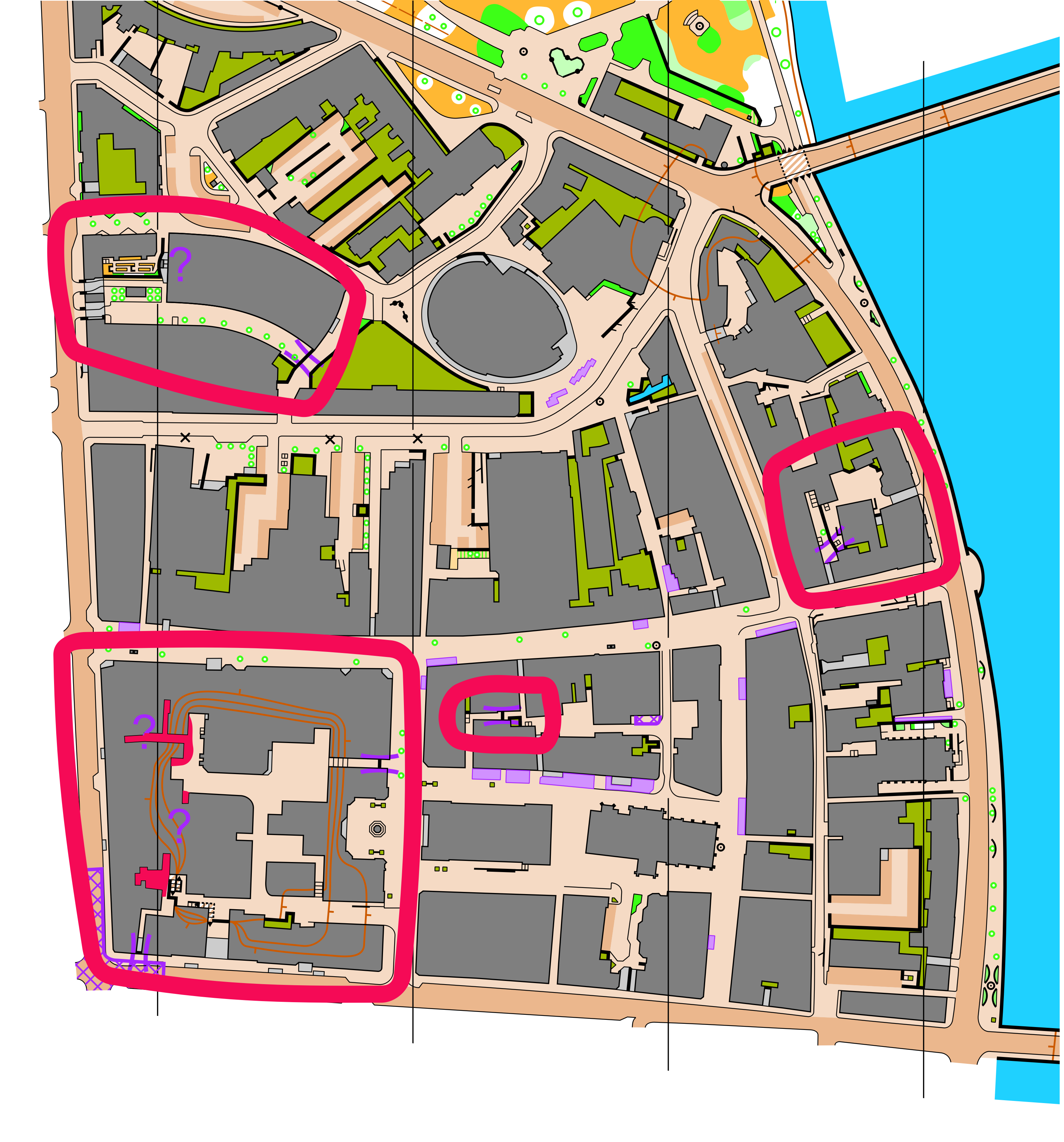
When we got the initial draft given to us by Graham there were 4 points he had marked as areas where we might be able to use if we had special permission, in the end we managed to get 3 of these and decided that the other (Kinnoul Street Car Park) was not worth the logistical effort.
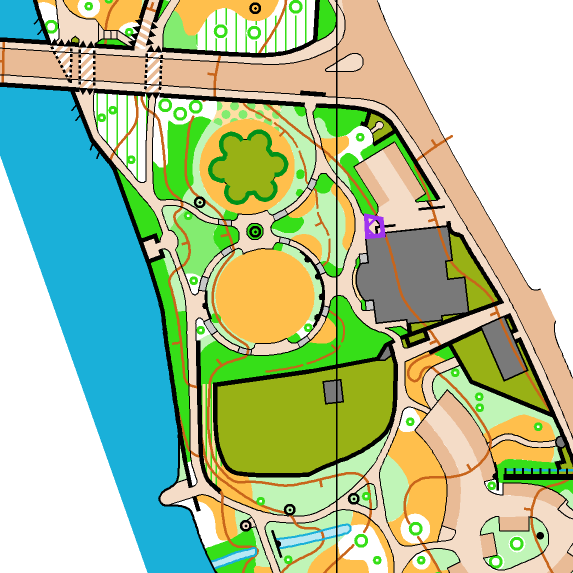
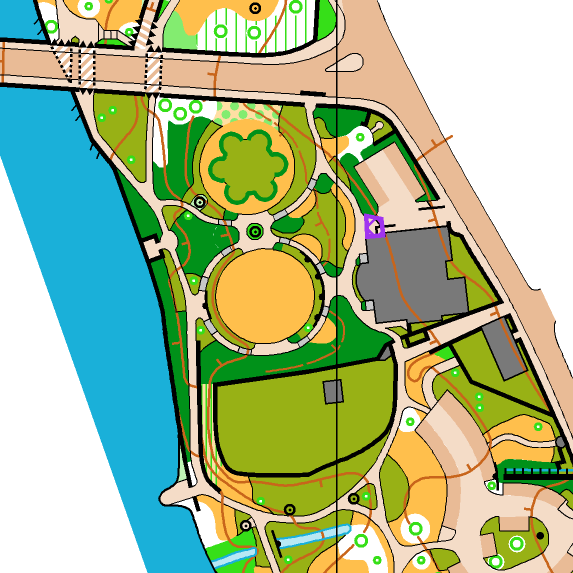
We also decided that Rodney Gardens, which was initially mapped as passable, would be better off impassable both for permissions sake (Not sure they would have been thrilled with 600 people trampling their flowerbeds), and to make the courses more interesting.
The Courses
The timeline for planning the courses can be split into 3 main stages.
1. The Initial Drafts
This constisted of just 4 courses, the ones we considered the most important to get as much feedback on as possible.
These were the 2 elite courses and the course 17 (M/W12) & 18 (M/W10). The reasoning for focusing on the elite courses is fairly obvious; we want these to be the highest quality possible. The two aforementioned junior courses are the only courses that don't have free reign in terms of difficulty, so we wanted to make sure that these were spot on.
2. The Final Drafts
Here, we sent drafts for all the courses to Keith, our controller, for review. And while they were sent as 'draft' course, they were effectively final as one issue we ran into is that there just isn't enough time to put a good amount of effort into every course, so unless Keith had any major concerns we weren't going to change them significantly.
Despite this, we wanted to ensure that no course was chucked under a bus and given a terrible course. We wanted to make sure that all courses had at least 1 or 2 good routechoices. For the courses starting at the Blue start. We ended up with 2 legs that could be used by most courses. These were from one side of the Bell Sports Centre to the other. And then from the sports centre car park to somewhere near the Wasps Creative Exchange. Both of these legs had several variants which changed the favourable routechoice depending on where the start/end controls were.
3. Final Courses
Once we had finalised all the courses we could get on with all the final tweaks that really pull eveything together.
One of the most important of these is circle and line cutting. This couldn't be done earlier on in the planning process because, when you cut a leg line in Condes, it marks either end of the cut as a fixed point on the map. So, if you were to then move one of the controls, you will create a bend in the line. I experienced this a lot back when preparing the courses for Big Weekend 2024, where I made the mistake of cutting the lines early on in the process and when there was the usual last minute changes, some bends were missed and got printed. Other tweaks include things like course number placement, control descriptions and exact barrier placements.
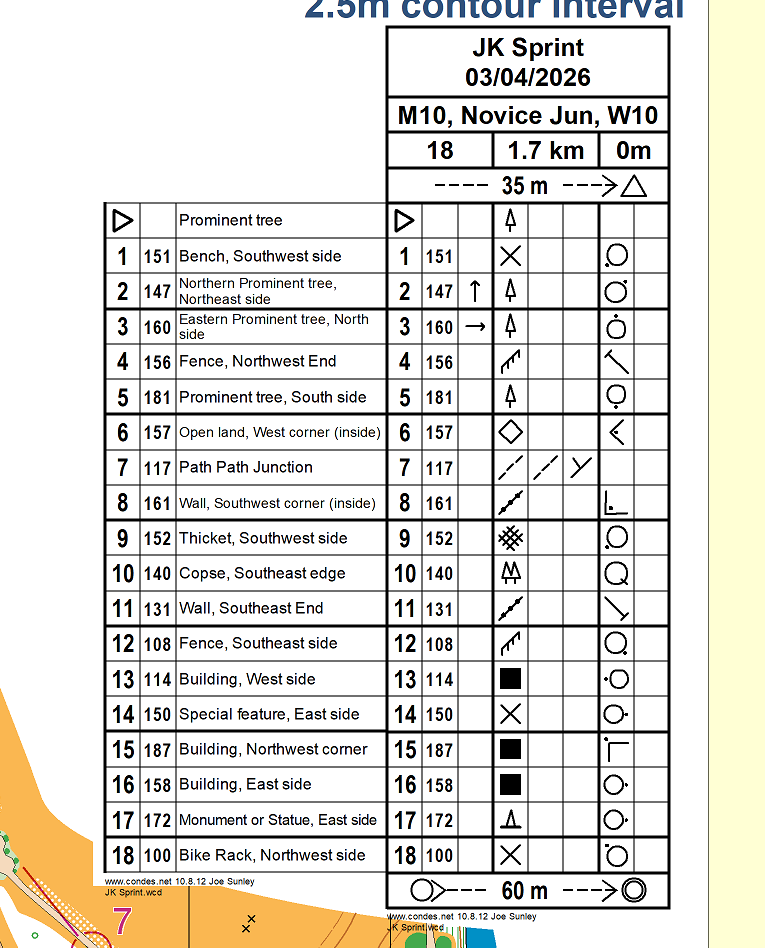
An interesting challenge with control descriptions was the inclusion of textual descriptions for course 18. We wanted to have both textual + pictorial descriptions, in case there were any competitors that weren't comfortable with descriptions in English. Purple Pen has a nifty feature that allows you to display both at the same time, however Condes only allows you to pick one or the other. I came up with a solution whereby description objects for both pictorial and textual were placed next to each other and on the textual descriptions I cropped all the duplicated info to make it match the Purple Pen offering as closely as possible.
4. The one you don't want to exist
Now I said there were 3 main stages to the planning process, but unfortunately that was a lie. As anyone who has planned before will know, there is always the last minute changes that need to be done.
We thought that we had avoided it, but a couple days after we'd sent our final course files to the printer we got a message from Jon saying we might need to change the courses. THe shopping centre still hadn't gotten back with a definite yes/no regarding the use of the service deck. This meant we needed to plan alternative courses that didn't use the service deck. Fortunately, we had decided from the get go that only the elite courses were going to use this section, so only they needed replanning. We came up with altenate courses that evening and got them checked by the relevant people.
A couple days later, Jon came back with the go ahead from the shopping centre, but with a few caveats. This meant another round of replanning, which fortunately wasn't too extensive.
So, eventually we got the courses sent off to print, a week later than planned, but still with plenty of time in hand.
The Pre-Event Prep
Once you've finished the courses there is still an awful lot of work to be done.
The maps got delivered to Jon on the 26th, so we collected them from him and had the fun job of counting every single map (over 2400) to ensure we had enough. While it's a tedious job, it's one you have to do as at Big Weekend 2023, there wasn't enough of one course and they ended up having to recycle competitors maps.
The next job is sorting out the plan for hanging the controls. We started by splitting all 91 controls into 13 hanging groups, averaging 7 controls per group. These were also nicely split into 3 in North Inch, 3 on the east of the Tay and 7 in the city centre.
As first start was 12:00, we decided that we could get away with just 4 control hangers: Me, Fiona & Fiona's parents. Fiona & I would start at 7am, with me taking the North Inch groups and Fiona the Eastern controls. Then, once we had finished those, Colin & Lorna would join us for the city centre controls, with the aim to have everything finished by 10:00. Unsurprisingly, we didn't quite manage this but we had everything out by ~10:30, plenty of time to sort anything else out.
As part of hanging, we needed to make sure we had enough kit, and that Colin & Lorna knew where specifically to hang controls. To do this, I made a spreadsheet where we could detail everything about a control, and then added some cool formulae to make things easy to view. Download the spreadsheet below to have a look at what I did.
In the end we needed 125 SI Units, 150 gripples and 51 trestles (more than was used for any event at WOC!).
The other bit of prep needed was to decide how we would be taping the flowerbeds at Rodney Gardens. We specified the following in the final details:
Where uncrossable features may be ambiguous, tape is used to denote the boundary of these features. This will not be done for all uncrossable features, and the absence or ending of tapes does not imply the end of an uncrossable feature.
This allowed us to only tape the bits we felt were necessary to prevent either accidental or deliberate encroachment onto OOB areas. I made a document as well as recorded a video of me going through all the sections needing tape so that my Dad would know where to put all the tape.
On The Day
As I said earlier, Fiona & I started hanging controls at ~7am. This was after a long night organising kit and getting our last preperations done. All controls were hung by 10:30 which gave me time to go and check Dad's taping.
After that, I did some flitting around Assembly before one of the marshals called in to say there was a bit of an issue with the shopping centre. I went over there to have a chat and it turned out they were not expecting us to be doing the things we were.
I'm not sure how this happened, but safe to say there was some miscommunications somewhere. It took a lot of walking through with the centre manager, but eventually we were able to keep the courses the same and only needed one extra marshal. It would have been an absolute disaster if we weren't able to go ahead as planned.
Once first start there really wasn't much to be doing. At one point, Jon got a report that someone was tampering with one of the controls so I legged it over to find no one there. I checked another control nearby just in case I'd been given the wrong code but that was also okay.
The only other thing that happened during the event was a complaint that 2 controls were too close together. Now, I knew that they weren't too close. The IOF rules on control distances for sprints is:
For Sprint map scales 1:4000 or 1:3000 the minimum running distance between controls is 25 metres and the minimum straight-line distance is 15 metres with no further restriction for similar control features.
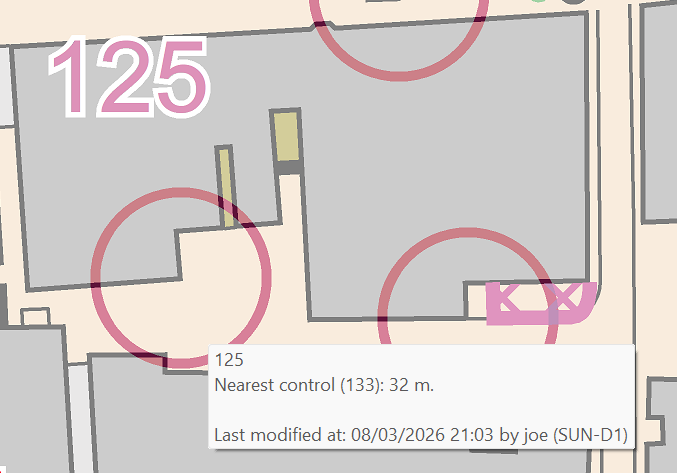
The rules explicitly state that there are no restrictions for similar control features, however this probably has a big part in why so many people mispunched on these 2 controls as they were both on the SouthEast Building Corner.
They were also 32m away from each other. However, the competitor wasn't satisfied with my explanation that they were far enough apart (I didn't have the exact number at the time), and they filed a complaint. Their complaint also stated that they had punched both controls, which was different to what other competitors were saying. This meant that there was also the issue of whether they could cover the ground within the maximum of 7s a SIAC flashes for after punching a control.
Covering the 32m in 7s is theoretically possible (~3:25/km), however 7s is a maximum and typically SIACs only flash for 5s (~2:25/km) and would have required the competitors to be running directly between the controls at their maximum speed. Based on this it was decided to reject the complaint, which the competitor accepted.
Once everyone had finished came the final task of collecting the controls. It's generally a lot easier to find control collectors than it is hangers, so we roped some people in to help with this and it went fairly quickly. Despite this, we were still at the event until 18:40 followed by a short drive to our accomodation for the rest of the weekend and a big flop.
Small things that are important to get right
While above I went through the major things that went into planning the courses. There are lots of smaller things that are important to a good event.
1. Emails
I received over 500 emails that were related to the sprint. And it was important that I regularly went through and archived emails that were no longer needed in order to reduce the clutter.
2. File Management
I set up a Sharepoint site that Fiona & I used in order to sync all the relevant files between all the devices we were using. This allowed, us to easily see what the other had been working on.
File management, also includes version control. At the last count, the master condes file had over 100 different versions stored on Sharepoint. Not all of these were relevant, but it was important that we could mark specific versions of the condes. These included any version that we sent to someone else. We did this by creating a copy of the master file and annotating with the current date & time so that we knew exactly which file was sent when.
3. Secrecy
It's always hard to be secret about courses for such a big event because there are always people that will need to see them for one reason or another. But it's always good to try and limit this where possible.
You also need to be careful as to what appears where. Following a test run we did in Perth, I managed to mess up privating Fiona's run and so that was public on Strava for about 20 minutes. Fortunately, it wasn't obviously clear where the courses went, and most people have some sense of honesty, so we weren't particularly concerned about the courses being leaked.
Hopefully this article was interesting and possibly even useful.
I haven't got comments set up on this site, so head over to my Attackpoint and leave a comment there if you've got any.